REVIEW · HO CHI MINH CITY
Highlights of Saigon City by Car
Book on GetYourGuide →Operated by Happy Plus Travel - GetYourGuide Partner · Bookable on GetYourGuide
Saigon in a car makes the day feel easy. This Saigon highlights tour strings together the places most first-timers want—market life, French-era architecture, and Vietnam’s modern history—without you worrying about the logistics.
I like two things most. First, the comfort: you get a private AC car plus pickup and drop-off at the center of Saigon, so you’re not scrambling between stops. Second, the experience is guided by a friendly pro who can explain things in Chinese, English, French, or Japanese—an extra help when you’re staring at detail you’d otherwise miss.
One drawback to plan around: the day can run anywhere from 4 to 8 hours, and your last history stop can be either War Remnants Museum or a return to Reunification Palace. If you’re tight on time or you care deeply about both, you’ll want to think about which theme matters more to you.
In This Review
- Key things to know before you go
- Why a Saigon Highlights Car Tour Works So Well
- Price and what $26 buys you (and why it’s fair)
- Your route: Ben Thanh to French landmarks to modern history
- Ben Thanh Market (1914): shopping energy with real local texture
- Saigon Notre Dame Basilica (1870s): French design, local devotion
- Saigon Central Post Office (1891): architecture with an old-world job description
- Reunification Palace: gardens, secret rooms, and a command bunker
- War Remnants Museum vs. staying with Reunification Palace
- Guide quality: how clear explanations change your whole day
- Comfort, timing, and group size: what to expect in real life
- Who should book this Saigon city tour by car
- Should you book this Saigon highlights tour?
- FAQ
- How long is the Saigon City tour by car?
- Where does the tour pick up and where do you get dropped off?
- Which sights are included in the tour?
- Do you have a live guide, and what languages are available?
- Is transportation included?
- What’s included in the price besides the car and guide?
Key things to know before you go
- Private AC car with central pickup/drop-off keeps your schedule smooth
- Live guide in 4 languages makes the architecture and history click
- Ben Thanh Market (1914) is your first real taste of everyday Saigon
- Reunification Palace covers gardens, secret rooms, antiques, and a command bunker
- War Remnants Museum OR Reunification Palace lets you choose your history focus
- Entrance fees and bottled water included so you avoid little add-on headaches
Why a Saigon Highlights Car Tour Works So Well
If you only have a few hours in Ho Chi Minh City (Saigon to many people), a car-based highlights route is a smart way to spend your energy. You’re not navigating from one far-flung landmark to the next. Instead, you’re moving like a local: point-to-point, with less time wasted and more time looking.
The big practical win is that pickup and drop-off are in the center of Saigon. That matters because it reduces the “start of day” stress. Add in a private AC car, and your sightseeing time stays pleasant even when your day includes multiple outdoor-to-indoor transitions.
You can also choose between private or small groups. That’s helpful if you want flexibility in pacing—especially on a day built around places with clear visual themes: colonial and French-era buildings, a major market, and then heavy historical sites.
You can also read our reviews of more city tours in Ho Chi Minh City



Price and what $26 buys you (and why it’s fair)
At $26 per person, this tour is positioned as good value because several costs that usually pop up later are already handled. You get entrance fees, bottled water, and a professional guide, plus the private AC transportation.
In other words, you’re not just paying for a ride. You’re paying for guided context at the places where context matters—like why the Central Post Office looks the way it does, or what Reunification Palace reveals beyond the main rooms.
The tour duration can be 4 to 8 hours, and that range is worth noting. If you book a shorter slot, you’re essentially buying a tighter highlights pass. If you book longer, you’re paying for more breathing room at sites where you might want extra time to absorb details.
Your route: Ben Thanh to French landmarks to modern history
The tour’s chosen mix makes sense because it covers Saigon from three angles:
- Everyday life at Ben Thanh Market
- French-era architecture through the Notre Dame Basilica and the Central Post Office
- 20th-century turning points via Reunification Palace and (optionally) the War Remnants Museum
You’ll also get to compare “history you can see” with “history you can understand.” The buildings are visual and specific. The museums add the explanations that turn those visuals into meaning.
Ben Thanh Market (1914): shopping energy with real local texture
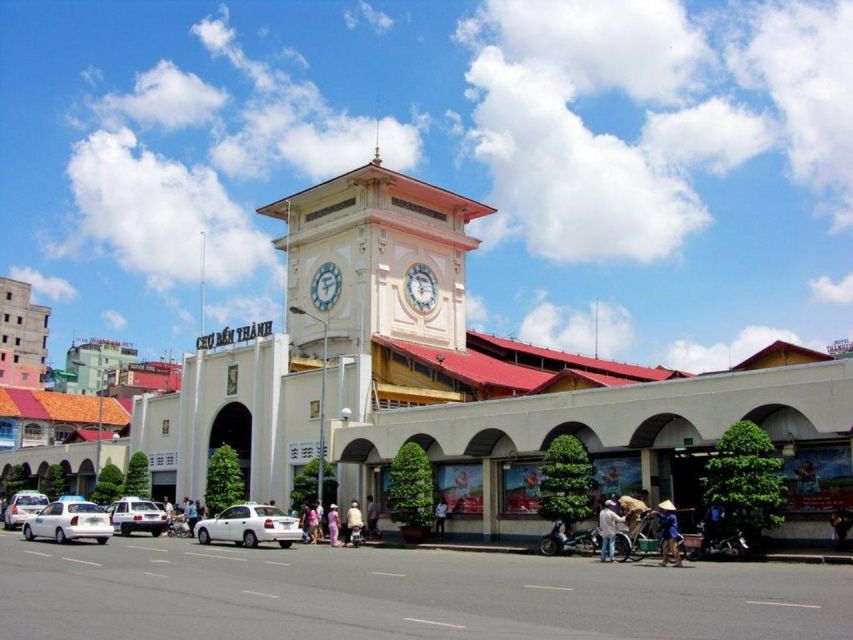
Ben Thanh Market is the kind of place that resets your brain. It’s not a quiet monument. It’s a working market with a strong sense of place, and it’s one of Saigon’s signature stops because it dates back to 1914.
You can expect a wide spread of things to see and browse—kitchen equipment, souvenirs, garments, foods, and fruits. Even if you’re not planning to buy much, the market helps you understand Saigon as a living city, not a museum list.
Practical tip: since the market is one of the first major stops, it works well as your “warm-up.” You’ll set your expectations for the day here, then shift into buildings where the value is in design and history.
Saigon Notre Dame Basilica (1870s): French design, local devotion
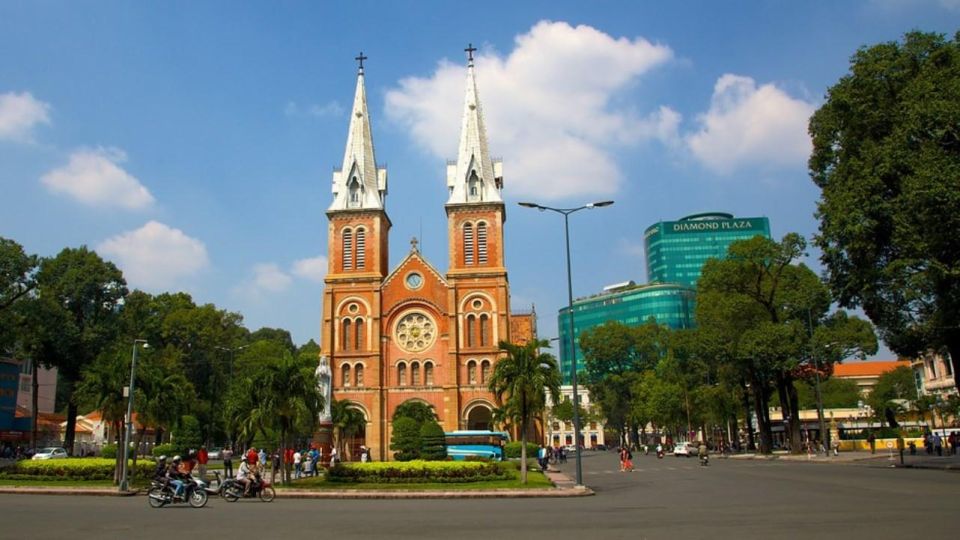
The Saigon Notre Dame Basilica is a standout because it feels both familiar and surprising. Designed by French architect J. Bourad in the 1870s, it’s described as neo-Romanesque and includes materials imported from France. That French design influence is easy to spot once you know to look for it.
It also has a cultural role beyond architecture. It’s commonly known as the Saigon church or the Virgin Mary church, and it’s a favorite spot for local couples’ pre-wedding photos. So you’re not just looking at a building—you’re watching a living tradition.
A useful consideration: because it’s a popular photo location, you’ll likely see people moving around for pictures. Plan to slow down and let the moment pass so you can actually take in the building details.



Saigon Central Post Office (1891): architecture with an old-world job description
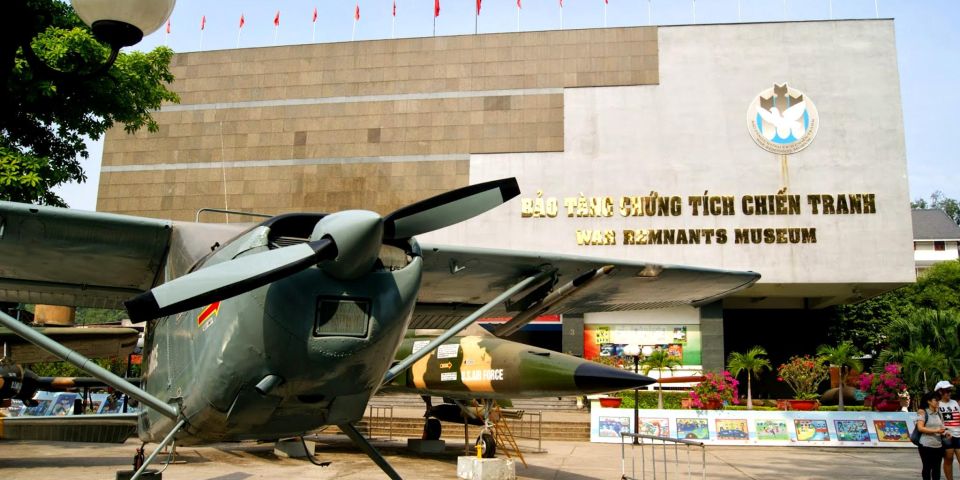
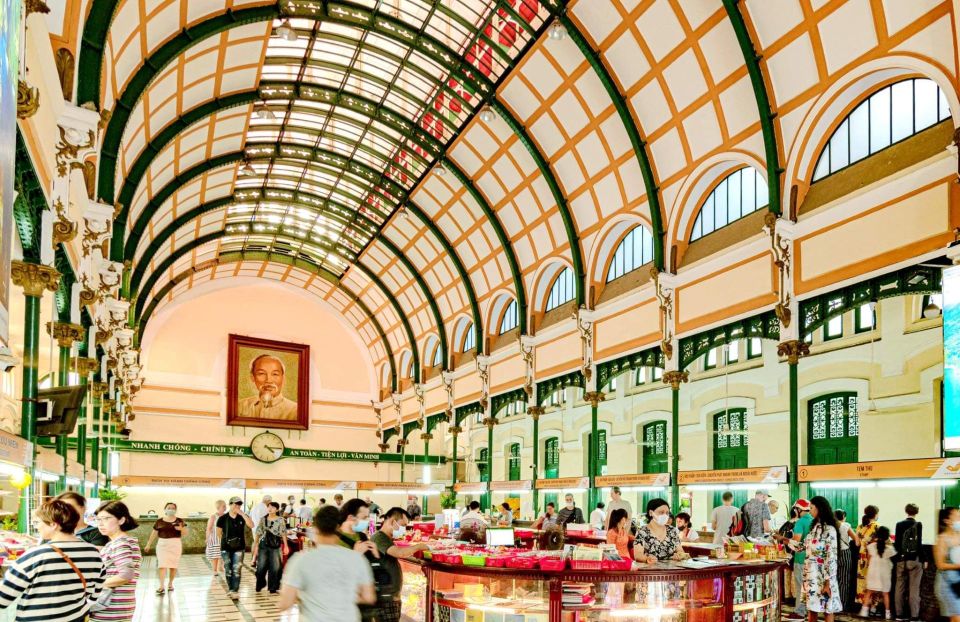
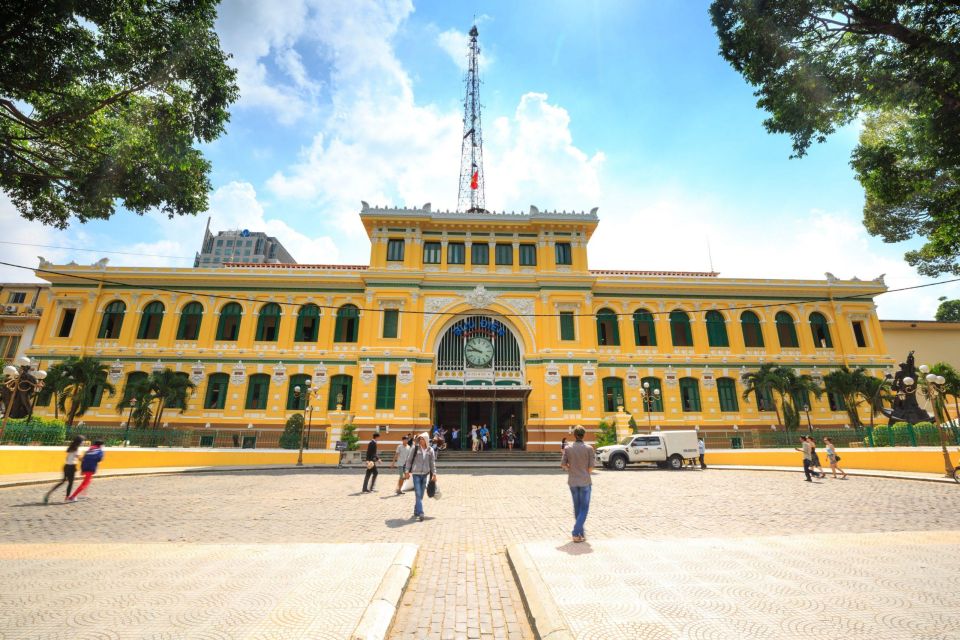
The Saigon Central Post Office delivers a different kind of wow. The structure is both functional and aesthetic, and it’s one of those places where you’ll understand why people keep photographing it.
Here’s a key detail that your guide should help connect: its architecture is not by Gustave Eiffel, but by Alfred Foulhoux. Knowing that name gives you a hook for the story—colonial-era influence isn’t generic here. It’s specific.
If you like design that serves a purpose, this stop is ideal. The post office doesn’t feel like a decorative set. It feels like a building that was built to work—and to look good while doing it.
Reunification Palace: gardens, secret rooms, and a command bunker
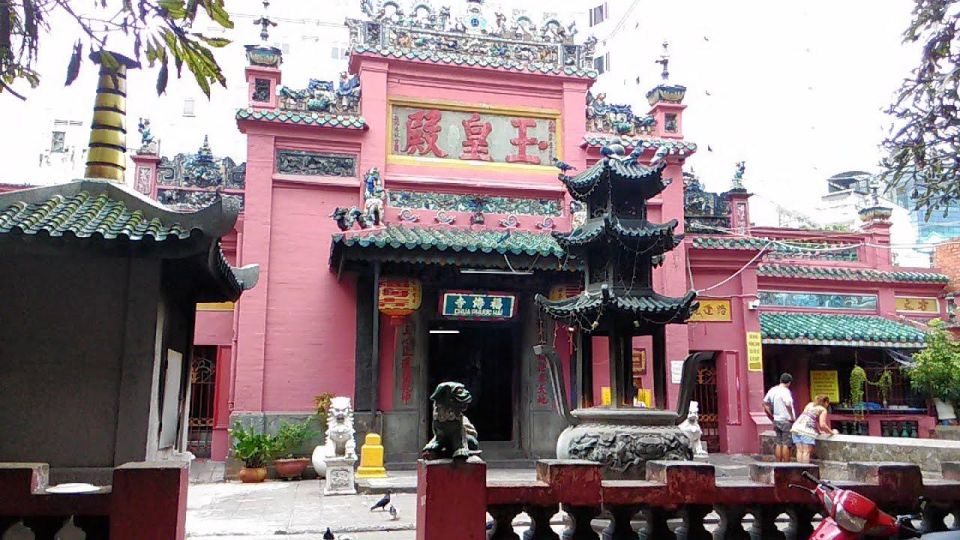
Reunification Palace is the stop that turns your sightseeing day into something more intense. The grounds come first—expansive gardens that set a calmer pace. Then you move into rooms and details that are harder to forget.
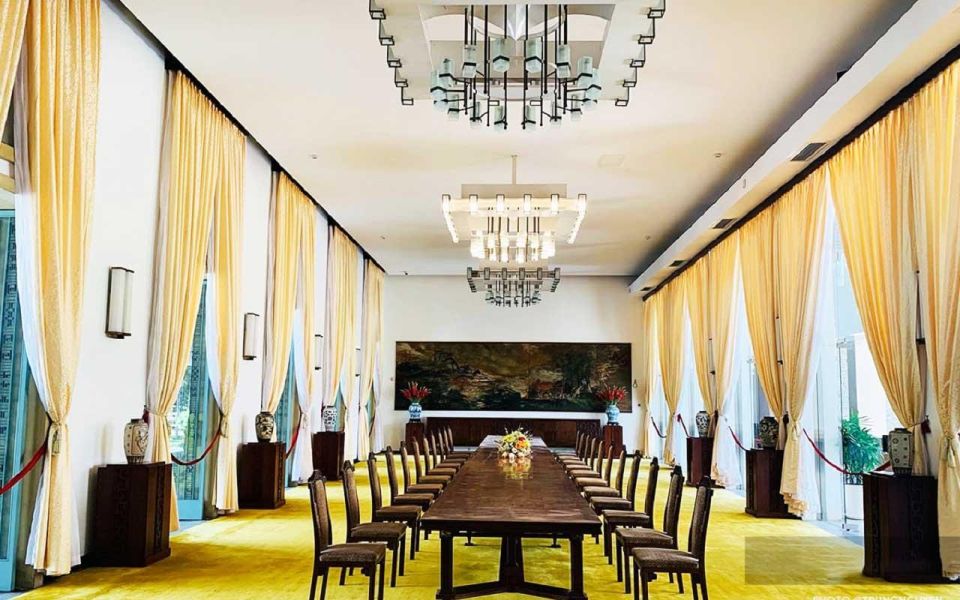
What makes it a major highlight is the variety inside: secret rooms, antique furniture, and a command bunker. Even if your main interest is architecture, you’ll still end up seeing how the palace was planned for real events, not just photo opportunities.
There’s also a note about atmosphere. The palace is described as having a Feng Shui ambiance—so it’s not only presented as a historical site, but as a designed space with traditional ideas about flow and balance.
How to get the most out of it: focus on the contrast. Pay attention to what feels open and public, then shift your attention to the spaces described as secret or command-focused. That change gives the palace its emotional punch.
War Remnants Museum vs. staying with Reunification Palace
Your final history option is War Remnants Museum OR Reunification Palace. That choice matters because these aren’t “the same thing, different location.” They target different ways of understanding the American War in Vietnam.
- If you choose the War Remnants Museum, you’re opting for a deeper understanding of the American War in Vietnam. This is the more direct historical framing option.
- If you choose Reunification Palace, you’re leaning into an iconic site that’s praised for its historical and architectural significance.
So how should you decide? If you want context and the broader story of the war, pick the War Remnants Museum. If you prefer to concentrate on one place and see how design and space reflect history, pick the Reunification Palace-focused route.
Either way, by the time you finish, you’ll have a day that moves from “everyday Saigon” to “design history” to “modern turning point.”
Guide quality: how clear explanations change your whole day
This is a tour where the guide can make a noticeable difference. The activity includes a friendly, professional guide, and you can get live interpretation in Chinese, English, French, or Japanese. That flexibility isn’t a small perk—these landmarks have names, dates, and design details that make more sense when you can hear them in your language.
Names from past experiences include Dao and Bori, both praised for clarity and for sharing lots of information about the country. That’s exactly what you want on a highlights route: someone who can turn buildings into stories, and stories into something you can remember.
If you’re the kind of traveler who stops reading museum signs after the first paragraph, you’ll still benefit here. The landmarks themselves are strong. The guide’s job is to connect the dots between what you see and what it meant.
Comfort, timing, and group size: what to expect in real life
This is a half-day to full-day style experience, scheduled in a 4 to 8 hour window depending on the starting time you pick. That range is practical: you can tailor it to your energy and what else you plan to do that day.
You’ll also be in either a private setup or a small group. Smaller groups tend to make the day feel less rushed and more adaptable when you want to spend extra time at one place—especially when photography and people-watching happen at sites like Notre Dame Basilica.
The tour also includes bottled water, and you’ll be in an AC vehicle for transit. Those small comforts add up when you’re moving between multiple key spots.
Who should book this Saigon city tour by car
I think this fits best if you want a high-efficiency highlights day without sacrificing comfort. It’s also a good match if you value guided explanations at places like:
- a classic market setting (Ben Thanh Market)
- French-influenced architecture (Notre Dame Basilica and Central Post Office)
- major 20th-century history (Reunification Palace and the War Remnants Museum option)
You’ll likely enjoy it most if you’re visiting the city for the first time, have limited time, or just don’t want to spend your day figuring out transportation between landmarks.
It’s also described as wheelchair accessible, and it offers private or small-group options, which can be helpful if you need a quieter pace.
Should you book this Saigon highlights tour?
Yes, I’d book it if your top goal is to see the core Saigon landmarks with the least friction. The value is in the mix: market energy plus design plus history, all tied together with guided context and a comfortable ride.
Before you click confirm, think about two things: first, whether you’re more interested in the War Remnants Museum storyline or in the focused architectural-and-historical experience of Reunification Palace. Second, choose a duration that matches your style—shorter if you want a clean highlights sweep, longer if you like to linger.
If you want a day that feels organized, guided, and still distinctly Saigon, this is a solid bet.
FAQ
How long is the Saigon City tour by car?
The duration is listed as 4 to 8 hours, and you’ll want to check availability to see the starting times.
Where does the tour pick up and where do you get dropped off?
Pickup and drop-off are included at the center of Saigon.
Which sights are included in the tour?
The tour highlights include Ben Thanh Market, Saigon Notre Dame Basilica, Saigon Central Post Office, Reunification Palace, and either War Remnants Museum or Reunification Palace (depending on the option).
Do you have a live guide, and what languages are available?
Yes, it’s a live tour with a guide. Languages listed are Chinese, English, French, and Japanese.
Is transportation included?
Yes. You’ll have a private AC car included.
What’s included in the price besides the car and guide?
Entrance fees and bottled water are included. Pickup and drop-off at the center of Saigon and a friendly and professional tour guide are also included.