REVIEW · HANOI
Hanoi Knife-Making Class:Join the Legacy in Blacksmith’s Workshop
Book on Viator →Operated by Photheculture · Bookable on Viator
A knife in the making, not in a shop. This Hanoi knife-making class takes you to Da Sỹ, a centuries-old blacksmith village, where you’ll build a blade step by step with expert guidance and a strong cultural story behind the work. It’s not just watching—your hands do the heavy lifting.
I love the hands-on process, from sketching a blade idea to hammering hot metal and shaping the tang. I also love the rare tar-based sharpening technique, taught as a family secret, which adds real character to the final step.
One consideration: this class is active, not a relaxed sit-and-smile demo. You’ll spend about 2 hours 30 minutes working through the stages, so come ready to focus.
In This Review
- Key highlights you’ll care about
- Why Da Sỹ’s knife workshop feels like craft, not souvenir shopping
- Step-by-step: design, forge, and shape your knife like you mean it
- 1) Design: sketching your blade idea
- 2) Forging: cut out the blade and tang
- 3) Shaping: hammering with guidance, plus edge refinement
- 4) Handling and finishing work on the handle
- The sharpening moment: the grindstone and a tar-based secret
- Meeting the experts: what the guide role actually does
- What you take home: a handmade knife you can actually use
- Who this class suits best (and who should think twice)
- Value in plain terms: is $45.51 a fair price?
- Timing, group size, and logistics that matter in Hanoi
- Tips to get the most from your knife-making day
- Should you book Hanoi Knife-Making Class?
- FAQ
- How long is the Hanoi knife-making class?
- What does the class cost?
- What’s included in the experience?
- Will I make and take home a knife?
- How big are the groups?
- Is it beginner-friendly?
Key highlights you’ll care about
- Da Sỹ village craft tradition: a long-running knife-and-blade making heritage tied to Vietnam’s wartime history
- Female-led forge time: work with the only officially recognized female artisan in the trade, with 44 years of experience
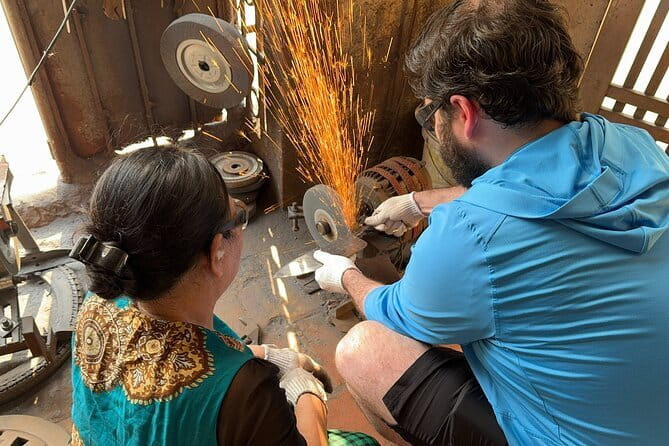
- Real tool access: you’ll use workshop tools and get safety gear, not just watch from the sidelines
- Design-to-sharpen workflow: sketch, cut out the blade and tang, hammer-shape, refine edges, then sharpen on a grindstone
- A unique tar wash: the sharpening includes a distinctive tar-based step passed down through generations
- Small group pace: capped at 10 travelers, which helps you get attention and feedback
Why Da Sỹ’s knife workshop feels like craft, not souvenir shopping
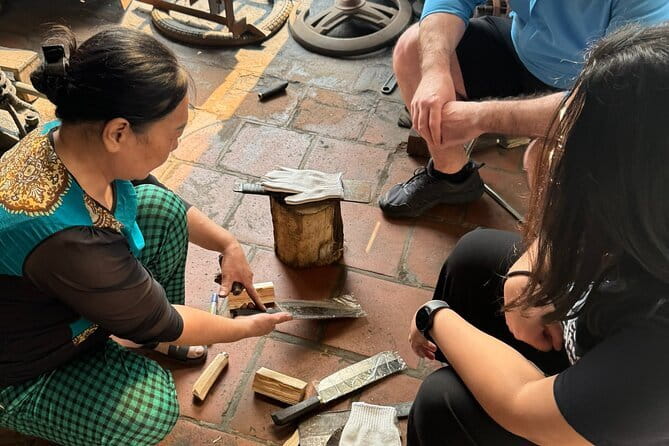
Da Sỹ is the kind of place that makes you understand why blades mattered so much in Vietnam. The area is known for centuries of forging tradition, and the work connects back to when local makers supplied weaponry during major periods of the country’s history. Standing in a workshop like this, you quickly see that the goal wasn’t decoration. It was function, durability, and skill.
The most compelling part for me is the person leading the forge. You work in a female-led blacksmithing setting, guided by a master artisan named Tuyên, recognized in the trade and credited with 44 years of preserving the craft. That changes the tone. You’re not just learning a technique—you’re meeting someone whose life is built around it, and the class respects that.
Then there’s the way the workshop balances technique with personality. Guides who help translate and keep you moving through each stage may include people like Mint, Nick, or Tulip (names that show up in the experience). They tend to make the day easier to follow, especially if you’re new to tools, heat, and metal shaping.
A few more Hanoi tours and experiences worth a look



Step-by-step: design, forge, and shape your knife like you mean it
The day runs like a sequence you can actually understand. You’ll start at the beginning and keep going until you end with a usable knife in your hands.
1) Design: sketching your blade idea
You begin by sketching your knife blade on selected metal. The instructors help you choose a piece that fits the goal—focusing on strength and quality rather than random “pick a shape and hope.” This early stage matters because the blade design isn’t just an art exercise. It’s tied to how the steel will behave later when it’s heated, hammered, and sharpened.
2) Forging: cut out the blade and tang
Next comes the work most people only see in movies: cutting out the blade and the tang (the part that fits into the handle). You use traditional tools—hammers, cutters, and an anvil. Then the steel goes into the forge to be heated for shaping.
This is where you feel the class is truly hands-on. You don’t just stand nearby while someone else does the job. You take turns, learning what each tool is meant to do. And because the workshop provides the tools and safety equipment, you’re not stuck figuring out basic safety on your own.
3) Shaping: hammering with guidance, plus edge refinement
Shaping is the moment you see your design take physical form. You hammer the metal into the desired shape side by side with the artisans. The pace is workmanlike—there are steps, checks, and corrections, so your knife doesn’t just become a rough rectangle with a cool story.
There’s also mention of a hydraulic machine used to refine rough edges for a smooth finish. That’s important because it balances tradition with practicality. You get the real “blacksmith” feel, but the workshop isn’t pretending you’ll create everything by hand power alone.






4) Handling and finishing work on the handle
The handle work is part of the craft too. One participant specifically noted that the handle starts as a block of wood with bark. That detail tells you the process stays grounded: wood prep and shaping aren’t a last-minute afterthought.
The sharpening moment: the grindstone and a tar-based secret
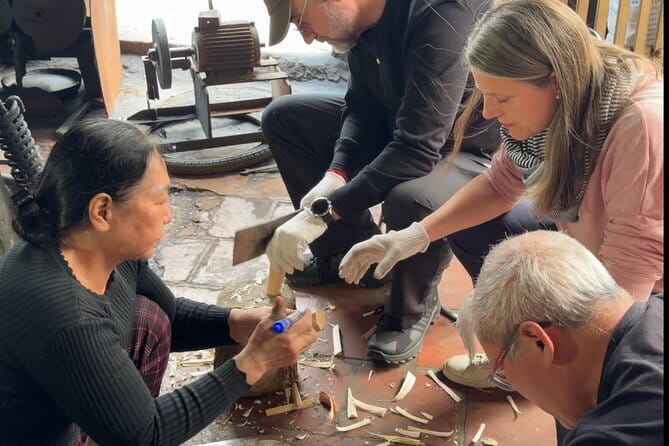
Sharpening is where the class becomes more than just metal sculpture. It’s the step that turns your project into a tool you’ll want to use.
You sharpen the blade on a grindstone, and the process includes multiple steps. One step stands out: a tar-based wash. The workshop frames this as an age-old family secret passed down through generations. That means you’re learning a method with a longer chain of knowledge than typical tourism classes.
Why does that matter to you? Because sharpening isn’t one move. It’s patience and repeated attention—getting the blade’s edge right so it holds up when you actually try it. Even if you’re not a “knife person” at home, you’ll leave understanding that good edges come from process, not luck.
Meeting the experts: what the guide role actually does
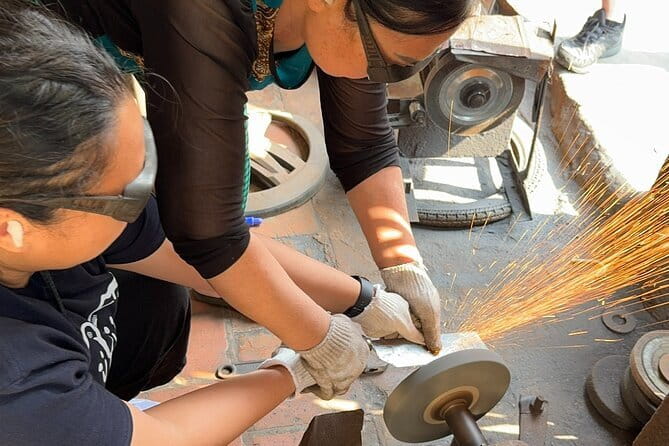
A lot of classes claim guidance. Here, the guide’s job seems practical: keep the day understandable while you focus on your hands.
If you’re working with an interpreter/guide like Mint, Nick, or Tulip, expect translation and step-by-step coaching as the craft moves quickly from forging to shaping to sharpening. Since the group size stays under 10 travelers, it’s easier for your guide to check in with you and make sure you don’t get lost when the work gets intense.
Also, because the artisan is a master with decades of experience, the guidance isn’t only about language. It’s about technique. You’ll get feedback when you need it, and that’s what helps beginners produce something that looks and feels real.
What you take home: a handmade knife you can actually use
The end result is not just a certificate and a photo. You take home your own handmade knife, built by your hands from design to sharpening.
The class emphasizes that it’s functional—something you can use for meals—so it’s not limited to “display purposes only.” One participant even mentioned airport logistics for shipping or flying with a knife and noted theirs was about 14 cm. That’s a useful reminder: even if your knife is meant to be a tool, you still need to handle it like a blade when you pack.
So what should you do with it right away? Treat it like you’d treat any new edge tool: plan for safe packing and check your travel rules before you rely on carry-on.
Who this class suits best (and who should think twice)
This is a strong fit if you want an experience that’s tactile, skill-based, and grounded in real craft.
You’ll likely enjoy it most if:
- You like hands-on workshops more than museum-style learning
- You want a small-group class with personal attention
- You’re curious about Vietnam’s metalwork tradition beyond a quick history talk
The trade-off is energy. This isn’t a slow “art class” where you take turns for a few seconds. You work through multiple stages across about 2.5 hours, and you’ll need patience and focus to get the sequence right.
If you’re very time-crunched, this may feel like a heavy block of your day. But if you’re in Hanoi with enough room to do one meaningful activity, this one is hard to beat.
Value in plain terms: is $45.51 a fair price?
At $45.51 per person, the value comes from what’s included and what you leave with.
You’re not paying for just a guided walk-through. The workshop provides the tools and safety equipment. You’re also paying for expert instruction while you create an object you can use: your own knife, finished with sharpening.
In other words, you’re getting a real craft lesson plus a tangible outcome. That’s usually where the best workshop value lives—when you pay for guided labor and skill transfer, not just the right to pose with a product.
Gratuities are optional, but if you felt your artisan and guide truly shaped your results, it’s worth thinking about a tip.
Timing, group size, and logistics that matter in Hanoi
The class runs about 2 hours 30 minutes (approx.). The schedule stays compact, which keeps it from dragging while still giving you enough time to complete forging and sharpening.
Group size caps at 10 travelers, so you’re not lost in a crowd. That tends to help with feedback and with time at the tools.
The meeting point is at Đa Sỹ, Kiến Hưng, Hà Đông, Hà Nội, Vietnam, and the experience ends back at the meeting point. The area is also described as near public transportation, which helps if you don’t want to rely on a private ride.
Tips to get the most from your knife-making day
You’ll have a better outcome if you treat this like a skills workshop, not just a novelty activity.
- Choose your design with care: your blade sketch sets the tone for everything after
- Pay attention during each turn: forging and shaping depend on small corrections
- Watch the sharpening steps closely: the tar-based wash is part of what makes this class distinctive
- Plan for safe travel with a blade: if you’re heading to the airport, check rules before you pack
If you want extra confidence, ask your guide for help translating the steps into something you can follow while you work. That’s one of the main ways an interpreter like Mint, Nick, or Tulip can make your day smoother.
Should you book Hanoi Knife-Making Class?
I’d book it if you want one day in Hanoi that feels real—craft, heat, tools, and a finished knife that you made yourself. The female-led forge with Tuyên’s 44 years of experience is a strong reason to go, and the tar-based sharpening step gives the day a detail you won’t get from generic “make-a-souvenir” classes.
Skip it only if you’re looking for a relaxed activity or you hate the idea of working through a full hands-on process for a couple hours. This is for people who like doing the work, learning by doing, and taking home something with weight and purpose.
If that’s you, this is one of the best ways to experience Hanoi beyond the usual streets and cafés.
FAQ
How long is the Hanoi knife-making class?
It lasts about 2 hours 30 minutes (approx.).
What does the class cost?
The price is listed as $45.51 per person.
What’s included in the experience?
All tools are provided at the artisan’s house, along with necessary safety equipment for knife making.
Will I make and take home a knife?
Yes. You’ll design, forge, shape, and sharpen your own handmade knife, and you take it home.
How big are the groups?
The workshop has a maximum of 10 travelers.
Is it beginner-friendly?
Most travelers can participate, and the class is designed for people to work through the steps with guidance from skilled artisans and an interpreter.