Hanoi on a scooter changes how you see the city. I like the fact that you ride pillion behind an experienced local driver, so you get street-level views without wrestling the traffic yourself, and I also like the smart mix of landmark stops plus everyday food moments. The main consideration: the roads feel intense at first, even when you’re safe and your driver keeps things calm.
Many of the guides people highlight by name—Jay and Sunny, Nick and Sunei, Brian, and Mr Ha—are praised for being friendly, alert, and good at setting a comfortable pace. In other words, the tour isn’t just about speed; it’s about getting your bearings fast while learning what you’re actually seeing.
Timing matters on this one. You’ll move around for about 4 hours, and the route includes a very specific 9 pm moment at the Ho Chi Minh Mausoleum, so you’ll want to be ready to start on time and keep your energy up.
In This Review
- Key things to know before you ride
- Why Hanoi by scooter works so well
- Safety and comfort: what the best guides do for you
- The first stops: St. Joseph’s Cathedral and train-track mural history
- St. Joseph’s Cathedral
- Phung Hung Mural Street
- Long Bien Bridge and the John McCain memorial: history you can see
- Long Bien Bridge
- John Sidney McCain Memorial
- Bia hoi and Huu Tiep Lake: beer and the B-52 story
- Bia hoi (fresh beer)
- Huu Tiep Lake and the Downed B-52
- The 9 pm Ho Chi Minh Mausoleum flag moment
- Price and time: is $63 good value?
- Who this scooter tour suits best (and who should rethink it)
- A Taste of Hanoi: what makes the experience feel “local”
- Should you book The Hidden Side Of Hanoi By Scooter?
- FAQ
- How long is The Hidden Side Of Hanoi By Scooter?
- Is this tour private, or will I share with other people?
- Do you get picked up?
- Will I drive the scooter?
- What stops are included on the route?
- Is the food or entry fee included?
- What if the weather is bad?
Key things to know before you ride

- Private group only: it’s just your group, so the pace and stops feel flexible for your day
- Pillion seating: you don’t drive; you ride with a local driver through real street traffic
- History with street access: cathedral, murals under the train tracks, bridges, and wartime sites
- Food + drink included: bia hoi (fresh beer) is part of the experience
- A specific 9 pm flag moment: the Ho Chi Minh Mausoleum stop is built around the exact time
- Local-guide names show up often: Jay, Sunny, Nick, Sunei, Brian, and Mr Ha are frequently mentioned
Why Hanoi by scooter works so well
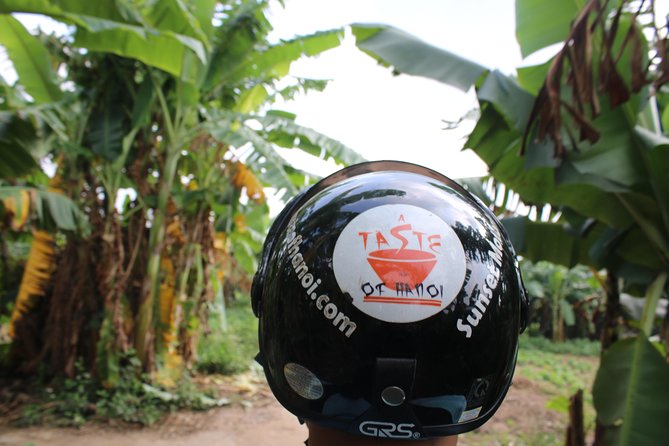
Hanoi’s traffic can feel overwhelming the moment you step outside. There are millions of motorbikes in a city of roughly eight million people, so the streets aren’t quiet and they’re not built for slow sightseeing. A scooter tour fixes that problem in a very practical way: you get movement, access, and context all at once.
I like that this tour leans into the real Hanoi instead of trying to replace it with a car-and-guide bubble. You spend time on streets that are part of daily life—narrow alleys in the Old Quarter area, bridge approaches, and lakeside roads—so you stop thinking in landmarks and start thinking in neighborhoods.
This is also a good first-day style activity. If you arrive and you’re already tired of standing in crowds, the scooter ride gives you a sense of scale and direction. You’ll come away with a mental map that actually matches what you’ll see later when you walk on your own.
A few more Hanoi tours and experiences worth a look


Safety and comfort: what the best guides do for you
On a scooter tour, you don’t just buy transportation. You buy confidence. The strongest praise in the stories about this experience is about the driver’s awareness—people describe guides who stay on top of the traffic flow and keep things under control.
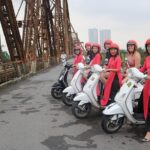
You’ll ride pillion with an experienced local driver, and that matters more than it sounds. It changes the whole feel of the day: you can look around, listen to explanations, and take photos without gripping handlebars or second-guessing the route.
That said, I’ll be honest about the one drawback that’s worth planning for. The beginning can feel scary if you’re new to motorbike traffic. To make it easier, dress for movement (nothing floppy), keep your phone and camera secure, and treat the first minutes as a “settling in” period. If you’re the kind of person who gets tense in fast-moving crowds, mention that to your guide at the start so they know to keep the pace steady.
The first stops: St. Joseph’s Cathedral and train-track mural history
Most scooter tours have a “wow” factor. This one earns it early by mixing big visuals with concrete stories.
St. Joseph’s Cathedral
Your first major stop is St. Joseph’s Cathedral, one of Hanoi’s oldest and biggest churches. You get a short talk on Hanoi and Vietnam under French rule, with time to take in the building’s scale. Admission is free here, which is a nice bonus because it keeps the experience feeling accessible.
What I like about starting with this is that the cathedral gives you a reference point. After that, the rest of the tour reads like a map of layers—colonial architecture, modern street art, and wartime memory—rather than random sightseeing.
Phung Hung Mural Street
Next is Phung Hung Mural Street, a long stretch of murals arranged along the arches under train tracks. Each mural section shows a slice of Hanoi’s history and iconic images from Vietnam.
The practical benefit: it’s outdoors and walk-friendly, so even with a scooter day, you’re not constantly strapped on a seat. The murals also give you something to photograph that isn’t a temple or a photo-op stall. It’s visual storytelling you can actually pause for.
Potential drawback to consider: if you’re expecting a “quiet” cultural stop, this isn’t it. It’s part of a working urban corridor under active infrastructure, so there’s motion around you.






Long Bien Bridge and the John McCain memorial: history you can see
After the mural walk-and-look, you ride out toward landmarks that feel more “local navigation” than “tourist postcard.”
Long Bien Bridge
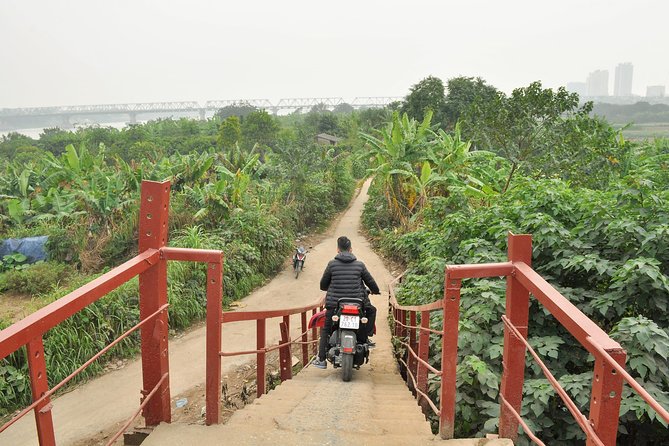
The Long Bien Bridge stop is short, but it’s a powerful one. Riding pillion behind your driver helps you experience how the bridge connects neighborhoods rather than treating it like a single photo viewpoint.
This is also where the tour’s “hidden side” promise becomes real. You’re not just moving between top-ten sites. You’re getting to the edges—places that often sit outside the quickest one-day itineraries.
John Sidney McCain Memorial
Next is the John Sidney McCain Memorial, connected to the fact that he was shot down near this area and was later helped by local men. The stop is brief, and admission is free, but the story gives the memorial weight.
I like that the tour doesn’t keep wartime history abstract. You’re shown a physical marker tied to a specific event. Even if you don’t know the details beforehand, it makes the location make sense.
If you’re sensitive to war-related topics, it’s worth knowing this is a theme of the day—especially later at Huu Tiep Lake—so you’ll want to be emotionally prepared for that shift.
Bia hoi and Huu Tiep Lake: beer and the B-52 story
This is where the tour earns its “more than sightseeing” reputation. You don’t just pass by; you get a included experience that connects food and memory.
Bia hoi (fresh beer)
At Bia Hoi, you’ll hear why this fresh beer is such a cultural product of conflicts and invasions. The tour frames it as something people developed and kept alive—so it’s not just a drink stop, it’s a story stop. Time is about 25 minutes, and bia hoi is included.
Practical tip for your day: go in with a light appetite mindset. If you’re sensitive to alcohol timing, you can still enjoy the cultural angle without drinking a lot—this is a guided “taste and learn” moment, not a party crawl.
Huu Tiep Lake and the Downed B-52
Next is Huu Tiep Lake and the Downed B-52 site, where parts of a B-52 plane came down. The tour notes that not much may be visible, but the point is understanding what happened—how the aircraft was shot down and landed in the lake.
This stop is short, but it’s meaningful because it ties the earlier memorial story to a physical wartime trace. Instead of you googling it later, you’re given the context while you’re standing in the location.
The 9 pm Ho Chi Minh Mausoleum flag moment
Not every tour includes a fixed-time experience, and that’s what makes the Ho Chi Minh Mausoleum stop stand out. You’re timed to arrive at exactly 9 pm to see the soldiers take the flag off.
That specific scheduling changes the feel of the day. You’re not just ticking a box during open hours. You’re showing up for a ritual moment that you can feel and remember because it has a clock.
Admission here is listed as free. You’ll also hear the story of Ho Chi Minh during your time at the mausoleum area.
A practical consideration: night timing means you should plan for walking and waiting while it’s cooler than daytime but still with urban nighttime movement around you. Keep a layer handy.
If you’re traveling with kids or you want a clear “finish strong” moment, this stop often does that job. It’s easy to understand, easy to witness, and it gives the day a memorable ending.
Price and time: is $63 good value?
At $63 per person for about 4 hours, this tour is priced in a way that makes sense if you value three things you usually pay extra for in Vietnam: guided interpretation, practical transport, and included food.
Here’s what you’re really getting for the money:
- Private transportation so you’re not stuck waiting on other groups
- Private tour (only your group participates) so you can focus and ask questions
- Pillion ride with an experienced driver, which is the main “ticket” to seeing Hanoi without white-knuckle stress
- Included moments like bia hoi and the Downed B-52 admission ticket
- Stops that combine free entrances (like St. Joseph’s Cathedral and Phung Hung Mural Street) with paid-included components
When a tour bundles transport and key entry/food moments, the per-person price feels less like a fee and more like a shortcut to time. You save time because the guide handles route decisions and timing—especially the 9 pm stop.
If you’re on a tight budget, you might be able to visit some of these places on your own. But the big “value” part is not the places themselves—it’s the ability to string them together efficiently while understanding what you’re looking at.
Who this scooter tour suits best (and who should rethink it)
This tour fits you best if:
- You want a first-day orientation of Hanoi that’s more useful than just wandering
- You’re okay with being on a motorbike in traffic, at least for a few hours
- You enjoy history tied to real locations—French-era architecture, bridges, memorials, and wartime sites
- You’d rather learn from a local guide than rely only on signage
It might be a weaker match if:
- You’re extremely motion-sensitive or you dislike traffic environments at all
- You need long, quiet museum-style pauses throughout the day (this route is more stop-and-go)
Also, the tour asks for moderate physical fitness. That doesn’t mean “sports workout,” but it does mean you should be comfortable with getting on/off the scooter and walking for short stretches between stops.
A Taste of Hanoi: what makes the experience feel “local”
The experience provider is A Taste of Hanoi, and the day is built around local wayfinding. Instead of treating the city like a list, it treats it like routes: under-rail murals, bridge connections, and water-adjacent wartime memory.
One thing I appreciate about this style of tour is that it forces you to slow down mentally even when your body is moving. Your driver handles the street problem; the guide handles the story problem. That combination turns traffic from an obstacle into scenery.
It also helps that guides are described as kind and fun, not stiff. If you enjoy conversations—questions about how Hanoi changes, what certain landmarks mean, and why these stories matter—you’ll likely have a better day than someone who prefers pure silent sightseeing.
Should you book The Hidden Side Of Hanoi By Scooter?
Book it if you want a Hanoi scooter tour that’s practical, time-efficient, and story-driven, with real local guidance and included food. The 9 pm flag moment and the mix of cathedral, murals, bridge, memorials, beer, and wartime sites make it feel like a complete “day in Hanoi,” not a few quick photos.
Skip it only if you know you can’t handle the idea of riding in traffic, even with a careful driver. If that’s not you, I’d treat this as a smart way to start your trip—especially if you want the city to make sense fast.
FAQ
How long is The Hidden Side Of Hanoi By Scooter?
The tour lasts about 4 hours.
Is this tour private, or will I share with other people?
It’s a private tour/activity, so only your group participates.
Do you get picked up?
Pickup is offered.
Will I drive the scooter?
No. You ride pillion behind an experienced local driver.
What stops are included on the route?
The tour includes St. Joseph’s Cathedral, Phung Hung Mural Street, Long Bien Bridge, the John Sidney McCain Memorial, Bia Hoi, Huu Tiep Lake and the Downed B-52, and the Ho Chi Minh Mausoleum.
Is the food or entry fee included?
Bia hoi is included, and admission ticket items are included for the Huu Tiep Lake and Downed B-52 stop. Other listed stops include free admission.
What if the weather is bad?
The experience requires good weather. If it’s canceled due to poor weather, you’ll be offered a different date or a full refund.