REVIEW · SOUTHERN VIETNAM
Phu My Port to Ho Chi Minh City Shore Excursion Private Tour
Book on Viator →Operated by Hiep Hoi An Travel · Bookable on Viator
Saigon in one smooth, guided day. You get a private air-conditioned minivan, a personal guide, and a tight route through the city’s biggest landmark hits, starting right at Phu My Port.
I especially love the way this day is structured to keep things moving without feeling rushed. Two standouts for me are the queue-free guidance at major sites and the included break with cà phê sữa đá plus lunch at a local spot.
One consideration: it’s still a long day (about 8 to 12 hours) packed with walking and city heat, so plan for comfort more than chill.
In This Review
- Key Highlights to Know Before You Go
- From Phu My Port to District 1: Getting Set Up for a Full Day
- Coffee and Lunch on the Schedule: How You Actually Keep Your Energy
- Saigon’s Neo-Romanesque Moment: Notre Dame Cathedral in 30 Minutes
- Central Post Office: The Grand Colonial Building You Can Walk Through
- Independence Palace: A 1975 Time Capsule With Real Spaces to See
- War Remnants Museum: Powerful, Graphic, and Best With a Game Plan
- People’s Committee and Opera House: When French Architecture Lights Up
- Chợ Lớn and Ben Thanh: Shopping and Street Food Without the Forced Frenzy
- Why the Day Feels Private: Guides, English, and Moving Through Crowds
- Price and Value: What $96 Buys You in a Port Day
- Who Should Book This Saigon Shore Excursion
- Should You Book It
- FAQ
- What’s included in the Phu My Port to Ho Chi Minh City tour?
- How long is the tour?
- Is this a private tour?
- Which main attractions are visited?
- Are entrance fees included?
- Is lunch included?
- Where does the tour start and end?
- Does the tour include a guide?
- What if the weather is bad?
- Is a mobile ticket used?
Key Highlights to Know Before You Go
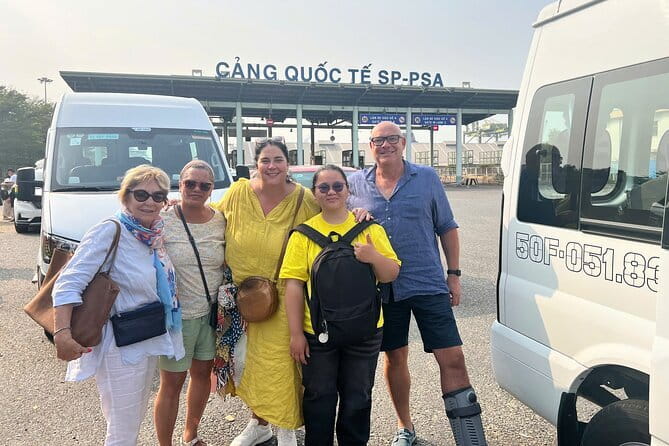
- Port pickup that gets you into Saigon fast so your day doesn’t melt away in transit
- Curated landmark flow through Notre Dame, Central Post Office, Independence Palace, and the War Remnants Museum
- Included coffee and lunch so you’re not hunting for food between stops
- Museum and palace time that’s realistic for a shore-day schedule
- Flexible shopping blocks in Chợ Lớn and Ben Thanh, when you want them (not when you must)
From Phu My Port to District 1: Getting Set Up for a Full Day
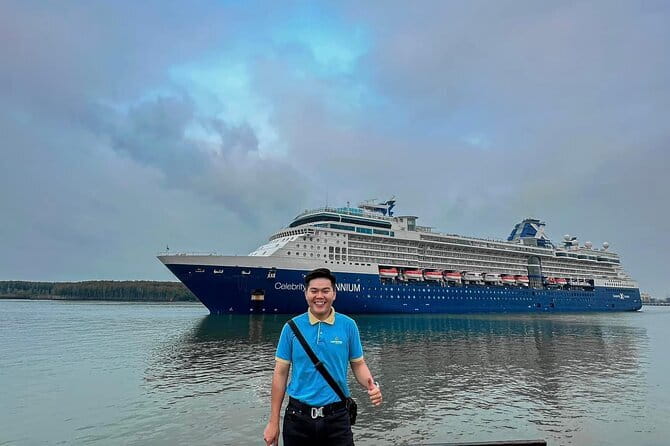
This shore excursion is built around one thing: getting you from the port into Ho Chi Minh City with minimal friction. The private pickup and drop-off at Phu My Port matters because timing is everything on a cruise day, and you don’t want to gamble with shared shuttles or meet-up chaos.
Once you’re in the city, you ride in an air-conditioned private vehicle. That’s not a small detail in southern Vietnam. Even when your stops are only about 30 to 45 minutes, the drive and waiting time add up fast, and A/C keeps the day from turning into a slow grind.
The other practical win is that you’re not stuck with a one-size-fits-all script. You can adjust the day to your interests as you go, which is huge when you’re sharing history time with people who like different things.
You can also read our reviews of more city tours in Southern Vietnam

Coffee and Lunch on the Schedule: How You Actually Keep Your Energy
The tour includes a glass/cup of Vietnamese coffee and a traditional lunch at a local restaurant (on the private option). I like this because it gives you a reliable “energy checkpoint” in the middle of a long day.
Cà phê sữa đá is the big focus here. It’s a sweet, iced Vietnamese coffee with condensed milk, and it’s a great reset between hot streets and indoor museum time. If you tend to get cranky when plans run late, this built-in break is a simple stress reducer.
For lunch, guides often recommend a top local pho choice. In at least a few real-day experiences, the guide picked a very strong pho spot and even sat with the group to walk people through what they were ordering and how to pace it.
If you have dietary needs, this is one of those moments where you’ll want to mention it early to your guide. The day includes one lunch stop, so adjustments have to happen within that slot.
Saigon’s Neo-Romanesque Moment: Notre Dame Cathedral in 30 Minutes
The day starts (or early-steps) at Saigon Notre Dame Cathedral in Paris Square, and it’s a smart pairing with the next stop. It’s one of the best-known colonial-era landmarks still standing in central District 1, and it has details that make photography easy even if you only have a half hour.
What makes this cathedral worth your attention is the mix of style and history. It was built by French colonists in the late 1880s, and it’s known for its neo-Romanesque look: the red brick façade, stained glass windows, and two bell towers. There’s also a quieter garden-like setting in the middle of downtown, which is a nice contrast to street traffic right outside.
There’s a specific name story too. The cathedral received the Notre Dame name after the installation of the Peaceful Notre Dame statue in 1959. Later, in 1962, it was given cathedral status as a basilica.
In 30 minutes, you won’t do a slow wander, but you can still get the big exterior views and step inside long enough to notice the windows and overall shape. Admission is included on the private option, which helps keep the day smooth.
Central Post Office: The Grand Colonial Building You Can Walk Through
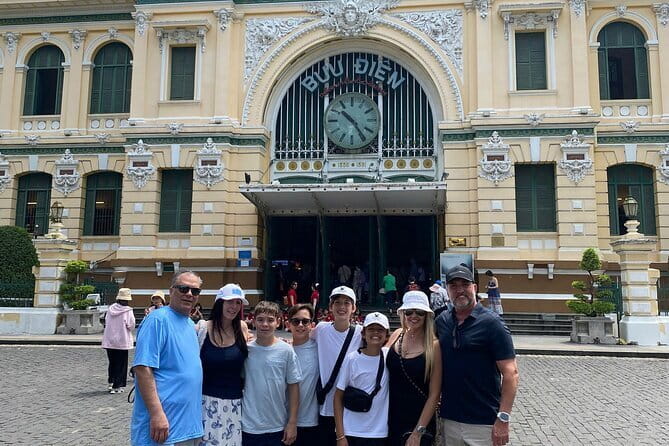
Next door is the Central Post Office, and the tour uses the fact that these two sites are adjacent. In practical terms, it’s efficient: you park your feet once, and you hit two major landmarks without losing time.
This is one of the grandest French colonial leftovers in Southeast Asia. The building was designed by Alfred Foulhoux and features arched windows and wooden shutters like you’d expect in late 19th-century style.
Even if you don’t care about postal history, it’s a good Saigon contrast stop. You’re not just looking at war and government buildings all day. Here you get architecture that feels designed for daily life—formal, orderly, and easy to imagine in the Indochina era.
You get about 30 minutes here. It’s enough to do the interior halls, take in the façade, and still keep the day’s pacing intact. Admission is included on the private option, which again helps avoid time-sink ticket lines.
Independence Palace: A 1975 Time Capsule With Real Spaces to See
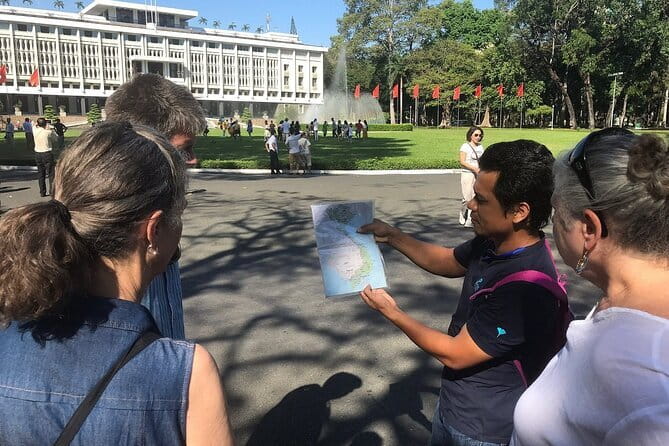
Independence Palace is the kind of stop that rewards a guide. It’s not just a building; it’s a frozen-in-time set of rooms tied to major events in Vietnam’s modern history.
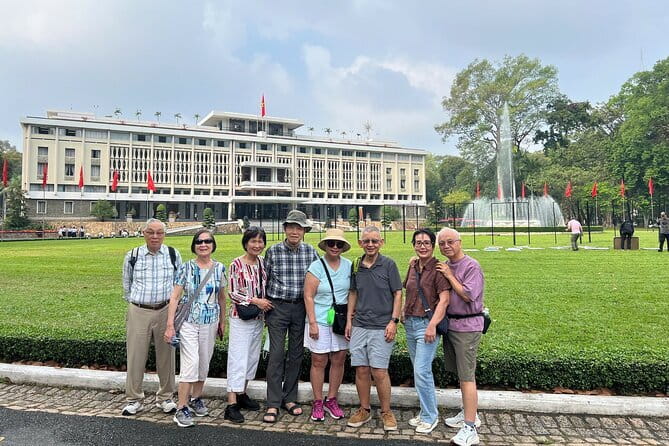
The palace was the base of South Vietnam’s General Ngo Dinh Diem until his death in 1963. It became internationally famous in 1975, when a tank of the North Vietnamese Army crashed through the main gate, ending the Vietnam War. Today it’s treated as a must-see because you can still walk through the spaces and grounds that connect to those moments.
A huge visual feature is the tank(s) parked in the palace grounds. The palace itself is described as like a time capsule frozen in 1975, and you’ll see original-style interiors and details such as secret rooms, antique furniture, and a command bunker.
You also get the sense the palace isn’t purely museum-only. It’s still used for important occasions, including APEC summits, which adds an extra layer beyond what’s on a history placard.
Time here is around 45 minutes. That’s usually enough for a careful route: exterior grounds glance, main interior highlights, and a focus on one or two “must-see” rooms rather than trying to inspect everything.

War Remnants Museum: Powerful, Graphic, and Best With a Game Plan
The War Remnants Museum is heavy. It’s intended to show the long and brutal Vietnam War in direct, sometimes graphic ways.
It opened to the public in 1975 and was formerly known as the Museum of American War Crimes. It contains graphic photographs and American military equipment. You’ll see big exhibits like a helicopter with rocket launchers, a tank, a fighter plane, and an attack aircraft. There’s also a conventional bomb described at about 6,800kg.
This is not the sort of place where you want to speed-run just because you have a schedule. The tour gives about 30 minutes, so you’ll need to pick what you can handle. If you prefer to understand the story, focus on the photo panels and the captions. If you’re more curious about equipment, aim for the weapons displays and read the exhibit context.
I like that the tour doesn’t pretend this museum should be a casual stop. You’ll feel it in your head afterward, and a break later on matters. If you’re sensitive to graphic material, consider asking your guide what sections are most intense so you can decide how much time to spend.
People’s Committee and Opera House: When French Architecture Lights Up
After the museum-heavy portion, the tour shifts into iconic civic and cultural architecture.
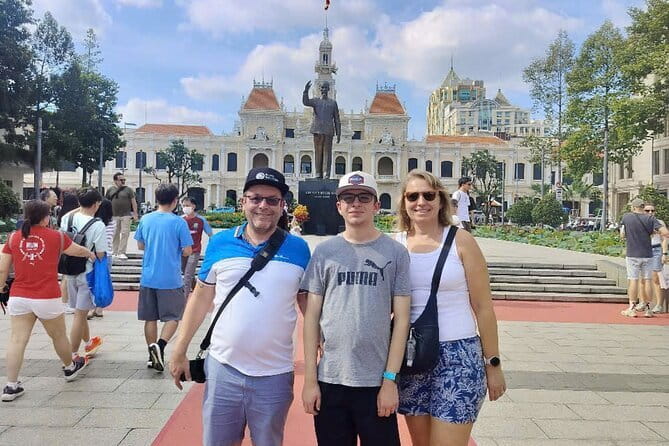
At the People’s Committee Building (Saigon), you’ll see well-preserved French colonial style set in a spacious garden landscape. The building originally constructed as a hotel in 1898 by French architect Gardes, later serving as city hall. It sits at the end of the Nguyen Hue walking promenade and has three buildings with embossed statues and intricate wall bas-reliefs, plus a statue of Ho Chi Minh in front.
Here’s a timing detail that’s actually helpful: the best time to visit is in the evening because features are illuminated with LED lights. This makes the stop feel more special than a daytime exterior photo.
Then you move to the Saigon Opera House (Ho Chi Minh Municipal Theater), near Le Loi and Dong Khoi in District 1. The restored building is three-storey and seats about 800. It was built in 1897 and is used for opera and other performing arts, including ballet, concerts, Vietnamese traditional dance, and plays.
In the same area as Notre Dame and the Central Post Office, this creates a clean “French colonial Saigon” loop. Admission is included on the private option, and you get around 30 minutes, which is enough for the exterior and to read what’s happening around the venue.
Chợ Lớn and Ben Thanh: Shopping and Street Food Without the Forced Frenzy
Two of the stops are the classic market-and-mood blocks: Chợ Lớn in District 5 and Ben Thanh Market in District 1. These are not admission-ticket sites, and the tour gives you time to move at your own pace.
Chợ Lớn (Phố Tau Sai Gon, Quận 5) is Ho Chi Minh City’s largest Chinatown, with roots dating back to 1778. The story is intense: Chinese minorities hid here from the Tay Son and later had to rebuild twice after attacks, with an estimate that up to 70% died escaping by boat. During the Vietnam War, Chợ Lớn became a black market area where US soldiers traded for supplies.
Today, it’s a tourist-friendly area with Chinese architecture and plenty of Chinese restaurants. You get about one hour, which is a realistic window to walk streets, spot photo-worthy architecture, and try snacks if you want.
Then it’s Ben Thanh Market, one of Saigon’s oldest landmarks. It’s great for handicrafts, branded goods, Vietnamese art, and souvenirs. There are eating stalls inside, so you can grab hawker-style food or a cold drink when bargaining gets exhausting.
The tradeoff is that Ben Thanh is big and can be hard to navigate. It’s also best avoided during the hottest part of the day. Night brings a street-side scene around the perimeter with food smells from grilled meats and wok-fried noodles.
This tour includes about one hour at Ben Thanh. That’s enough to feel the place and shop with intent, without getting stuck in a maze for hours.
Why the Day Feels Private: Guides, English, and Moving Through Crowds
The “private” part shows up in how smooth things are between stops.
In real-world examples from this exact tour experience, guides like Richard, Rachel, Anthony Nguyen, and Nguyen Duc Tien have been singled out for making the day feel tailored and easy. People also note guides with strong English, plus the ability to help with communication at lunch and in daily interactions.
Another common advantage is minimizing standing around. With a guide working the route, you’re less likely to lose time to wandering and waiting. That matters even if every stop is “only” 30 minutes on paper.
You also have room for small choices. If you want more time looking at architecture and less time shopping, your guide can usually shift the balance while staying within the overall schedule.
Price and Value: What $96 Buys You in a Port Day
At $96 per person, this is not the cheapest way to do Saigon. But for a shore excursion, it can be strong value because several big-ticket parts are handled for you.
You’re paying for:
- Private air-conditioned transportation with port pickup and drop-off
- A professional guide (on the private option)
- A built-in break with Vietnamese coffee
- Traditional Vietnamese lunch
- Admission tickets for the major sites on the private itinerary
If you tried to piece this together yourself—cab to multiple landmarks, paid entry for several museums/palaces, and time lost organizing it—you’d likely spend comparable money without getting the same pacing.
The day is also built to fit a limited schedule. The included stops cover a wide range: architecture, government history, and wartime memory, plus markets for a more everyday Saigon feel.
Group discounts exist too, which can improve the value if you’re traveling with others.
Who Should Book This Saigon Shore Excursion
This tour is a good fit if you:
- Have a limited day and want major sights covered in one pass
- Like history that spans colonial architecture, independence-era spaces, and war memory
- Want a guide who can explain what you’re seeing and help you connect with the city
- Prefer a private vehicle over shared logistics
It’s also a solid choice if you’re visiting first time or coming from a cruise and need a dependable plan from the moment you step off the ship.
Should You Book It
If your goal is to get your bearings fast and see the main landmarks without wrestling ticket lines and transit problems, this is worth considering. The combination of private A/C pickup, included coffee and lunch, and admission for multiple big sites makes the day feel efficient.
The biggest reason not to book is simple: if the War Remnants Museum’s graphic content would be too much for you, you might need to adjust your expectations before committing. If you’re comfortable with heavy material and you want a full, structured Saigon day, this tour does a good job covering the essentials in a single shot.
You can also make it work better by walking in the morning when possible, keeping shopping flexible for later, and using the guide to set priorities if your group has different interests.
FAQ
What’s included in the Phu My Port to Ho Chi Minh City tour?
It includes private port pickup and drop-off, an air-conditioned vehicle, a glass/cup of Vietnamese coffee, and a Vietnamese traditional lunch on the private option. Admission tickets are included on the private option.
How long is the tour?
Plan for about 8 to 12 hours, depending on the schedule.
Is this a private tour?
Yes. It’s a private activity, so only your group participates.
Which main attractions are visited?
You’ll visit Saigon Notre Dame Cathedral, the Central Post Office, Independence Palace, the War Remnants Museum, the People’s Committee Building, and the Saigon Opera House. The day also includes time for Chợ Lớn and Ben Thanh Market.
Are entrance fees included?
Entrance fees are included on the private tour option for the listed stops.
Is lunch included?
Yes. A traditional Vietnamese lunch is included on the private option.
Where does the tour start and end?
It starts at Phu My Port (Đường số 3, TT. Phú Mỹ, Tân Thành, Bà Rịa – Vũng Tàu, Vietnam) and ends back at the meeting point.
Does the tour include a guide?
A professional tour guide is included if you select the option with guide or private tour.
What if the weather is bad?
The experience requires good weather. If it’s canceled due to poor weather, you’ll be offered a different date or a full refund.
Is a mobile ticket used?
Yes, the tour uses a mobile ticket.