REVIEW · HO CHI MINH CITY
Night Bus Tour in Ho Chi Minh City
Book on Viator →Operated by ANH VIET HOP ON - HOP OFF VIET NAM · Bookable on Viator
Ho Chi Minh City looks different after dark. You get night views of the city’s landmarks for a small price, plus double-decker sightseeing from the streetlight glow. It is built for people with limited time, since the bus runs a set route and keeps moving.
One thing to keep in mind: this is a non-stop ride, so you are not meant to hop off and explore along the way.
In This Review
- Key things to know before you board
- Night Bus Tour in Ho Chi Minh City: the quick overview that actually helps
- Price and value: why $7.50 can make sense here
- Departures, timing, and how to pick the right night
- Non-stop route reality: what the ride feels like
- Boarding points: where you start and how to avoid confusion
- Comfort on a double-decker bus: seats, rain, and what is actually included
- The landmark loop: what you pass and why each stop matters
- Nguyen Hue Street: lights first, details later
- People’s Committee headquarters (Hotel de Ville area): classic grandeur in motion
- Central Post Office and Notre-Dame Cathedral area: European lines with Vietnamese context
- Ba Son Bridge: a modern river crossing in the middle of the story
- War Remnants Museum area: the sobering stop in a light-driven tour
- Bui Vien Street and Ben Thanh Market: nightlife energy and a classic symbol
- Bitexco Financial Tower: the skyline shot
- Bach Dang Pier: the romantic river edge moment
- Saigon Opera House (Ho Chi Minh Municipal Theater): French colonial beauty
- Audio guide and earphones: how to make sure you actually get the commentary
- Traffic and route changes: why your hour might feel longer
- Who this tour is best for (and who should skip it)
- Should you book this night bus tour? My recommendation
- FAQ
- FAQ
- What times does the night bus run in Ho Chi Minh City?
- How long is the tour?
- Is this tour hop-on hop-off?
- Where do I meet the bus?
- Are audio guides available, and in what languages?
- What is included with the ticket?
- Do I need to bring my own water bottle?
- What should I expect if there is traffic or bad weather?
Key things to know before you board
- It is a set route, not hop-on hop-off: if you get off, you cannot re-board.
- Two departures windows: 16h00–22h30 (about every 30 minutes) and 23h00–next morning (about every hour).
- Audio guide in many languages: English, French, German, Spanish, Chinese, Japanese, Korean, Vietnamese.
- Main boarding point is right by Nguyen Hue: 92–96 Nguyễn Huệ Street in District 1.
- Small group feel on board: the tour caps at 15 people (per run), which helps with boarding flow.
- Comfort extras are included: WiFi, air-conditioning, an included earphone setup, plus a hat/raincoat and bottled-water supply.
Night Bus Tour in Ho Chi Minh City: the quick overview that actually helps

If you want a fast first look at Ho Chi Minh City, this night bus tour is a practical move. For around $7.50, you’re buying time saved, not a deep, slow-paced museum-style tour. The bus follows a route that strings together the places most visitors photograph, with the city’s lights doing most of the work.
The best part is how naturally it fits a tight schedule. You can plan your evening around a departure time (instead of rearranging your entire night). And since it is a one-hour loop, you still have energy left for dinner plans or a quick wander afterward.
You can also read our reviews of more city tours in Ho Chi Minh City



Price and value: why $7.50 can make sense here
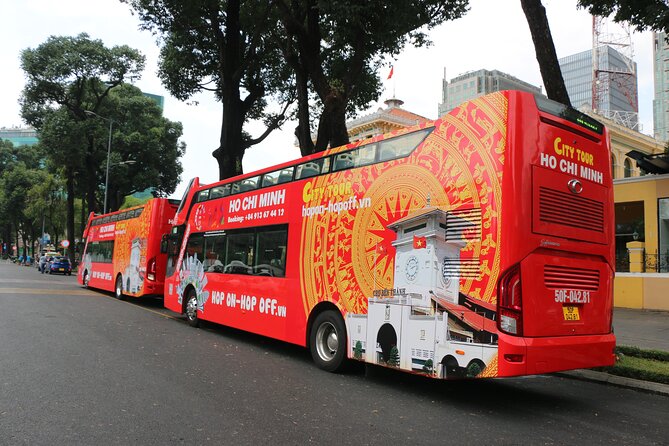
Let’s be real: $7.50 is not the price of a guided walking tour. You are paying for three things: a timed departure, a comfortable ride, and a prepared route through the most iconic District 1 sights.
You also get a bundle of helpful perks listed with the tour: WiFi on board, air-conditioning, an earphone setup, a city map, insurance on the bus, plus practical extras like a conical hat and a raincoat. Water is included too, with the operator encouraging you to bring a reusable bottle to refill.
Where the “value” comes in is convenience. If you have one evening and want the big names—Opera House, Notre-Dame Cathedral area, Ben Thanh Market area, the War Remnants Museum area—this tour helps you build your bearings without spending extra time commuting or searching.
Departures, timing, and how to pick the right night
The tour runs in two main time windows, each designed for different crowd levels and lighting.
- Night tour: 16h00–22h30, with departures about every 30 minutes.
- Midnight tour: 23h00–next day 7h00, with departures about every hour.
Because the bus is non-stop and the route can shift for traffic, your exact timing matters. In heavy evening traffic, you might spend longer sitting and less time sightseeing. If your goal is maximum landmark visibility, you will usually have an easier time picking a departure earlier in the window—when streets can still be lively but not fully gridlocked.
Also note: the route and schedule can change due to traffic, public holidays, weather, or unforeseen events. On rainy nights, even a short delay can snowball into long waits for a moving bus.
Non-stop route reality: what the ride feels like
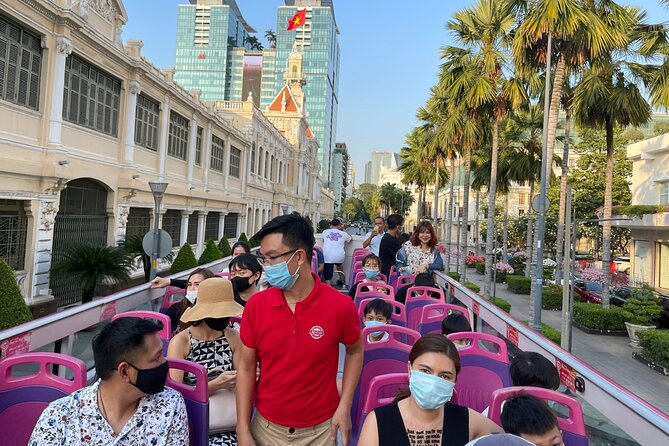
This is not hop-on hop-off. The bus goes around the city without stopping, and the tour ends back near the Nguyen Hue area (Nguyễn Huệ walking street is specifically mentioned as the end point). That setup turns the experience into something like a moving city-light photo session with audio.
The non-stop format is great for people who hate planning. You get carried along a loop and do not have to negotiate crossings or parking lots. But it also means you should mentally lower your expectations for how much you will see up close. You are watching from the bus as the city slides by.
It also affects the usefulness of audio. If the bus crawls due to traffic, you may hear audio longer than you want, and the landmarks can blur past your window. If you’re the kind of person who loves reading details on facades, this tour may feel more like an overview than a guidebook in motion.
Boarding points: where you start and how to avoid confusion
Start at 92–96 Nguyễn Huệ, Bến Nghé, Quận 1. That is your main meeting point, and it is also the area where the tour ties back to at the end.
There is also an additional listed option: No. 2 Cộng Xã Paris Street, District 1 near the Central Post Office. The info says you can wait for the bus there and board as it travels between Nguyen Hue and that area (it’s described as taking about 5–10 minutes).
My advice: go early and reduce stress. Even small delays at boarding can cut into your confidence on a non-stop ride. And because the tour can shift due to traffic, you do not want to be hustling to catch the first minute of the departure.
You can also read our reviews of more evening experiences in Ho Chi Minh City




Comfort on a double-decker bus: seats, rain, and what is actually included
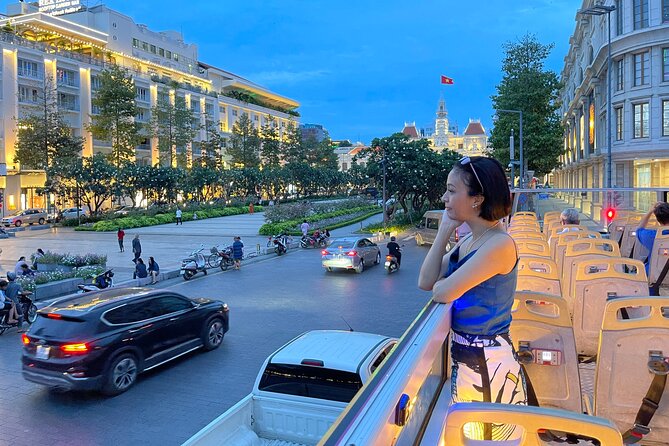
This tour is designed with comfort in mind, especially for evening weather changes. The included conical hat and raincoat are there for a reason: Ho Chi Minh City can move from warm to rainy fast.
You also get WiFi on board and air-conditioning. That matters when you’re dealing with evening heat or when traffic slows and the bus becomes stationary for stretches.
Two practical tips if you care about views:
- If there is a rooftop-style option on your bus, it can dramatically improve your city-light photos.
- If you’re near where you can hear audio more clearly, it can help—because audio quality and timing can vary depending on road conditions.
The landmark loop: what you pass and why each stop matters
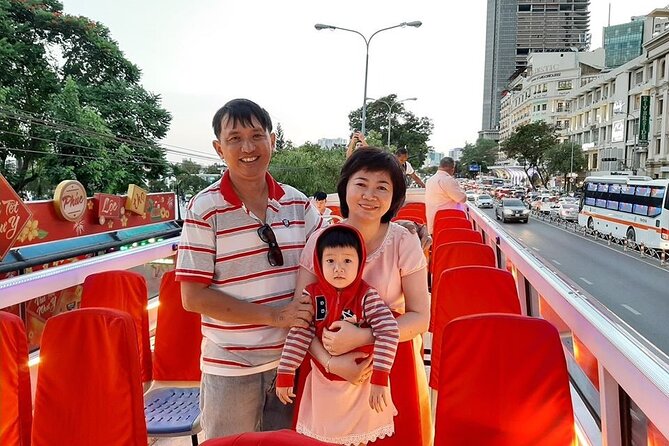
The route covers a mix of French colonial-era architecture, modern skyline moments, river scenery, and major history stops. Since the bus does not stop for you to get out, think of these as look-and-learn moments. You’ll see them from the street or roadside vantage, with audio helping you place what you are looking at.
Nguyen Hue Street: lights first, details later
You start around Nguyễn Huệ walking street, a bright, pedestrian-focused stretch that’s packed in the evening. This is a good “welcome to the city at night” setting. Even if you’re arriving tired, the light show helps you reset your energy.
Drawback: since it’s an active nightlife zone, traffic can be intense around it. If you are on an earlier departure, you’re more likely to roll out smoothly.
People’s Committee headquarters (Hotel de Ville area): classic grandeur in motion
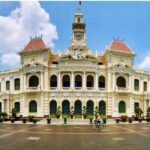
The route includes the headquarters of the People’s Committee of Ho Chi Minh City, formerly the Hotel de Ville in the French colonial period. That building is a big part of the city’s “old meets new” look, and from the bus you’ll get the shape and presence without needing time for a standalone visit.
It’s a great orientation stop because it shows you how the city’s historic layers still power today’s skyline.
Central Post Office and Notre-Dame Cathedral area: European lines with Vietnamese context
The Central Post Office is described as a classical European architectural style building with decorative lines of Asian style. Next comes the Saigon Notre-Dame Cathedral, built in 1877 and consecrated in 1959, blending Romanesque and Gothic elements.
These are usually the landmarks people are most excited to see at night. The practical catch is timing: people often aim for the moment the lights really pop. If your departure is a bit early or the bus hits traffic, you might not see the full effect you hoped for.
Still, even from the road, the lighting and the proportions tend to come through clearly.
Ba Son Bridge: a modern river crossing in the middle of the story
The bus also passes Ba Son Bridge, a major 6-lane bridge opened in 2022 that links District 1 and Thu Duc City over the Saigon River. In a night tour, this is a “scale” moment. It shows the city is not only heritage buildings—it’s also big engineering projects and fast change.
If your photo comes out slightly blurred, that’s not your fault. The bus ride is the trade-off.
War Remnants Museum area: the sobering stop in a light-driven tour
The route includes the War Remnants Museum area, where exhibits and documentation cover consequences and crimes connected to wars in Vietnam. On a night bus, you typically won’t get to read much, but you’ll at least see the location and understand why it matters.
This is the stop that reminds you: even on a fun lights tour, Ho Chi Minh City’s history is never far away.
Bui Vien Street and Ben Thanh Market: nightlife energy and a classic symbol
The route passes Bùi Viện Street, known as the Western Street for its Western-culture-oriented vibe, and then Ben Thanh Market, a central symbol of the city and one of the earliest surviving structures.
Bùi Viện is where the night gets loud and social. Ben Thanh gives you a sense of place and tradition right in the middle of the modern city.
Because this tour is non-stop, consider these as “pass by and recognize” stops. If you want to shop or eat properly, you’ll still need a daytime return or a separate evening plan.
Bitexco Financial Tower: the skyline shot
The bus goes by Bitexco Financial Tower, a prominent high-rise with 68 floors above ground and a height listed at about 262.5 meters. At night, skyscrapers like this tend to show up best from a moving vehicle—lights reflect, and the scale hits fast.
If you want skyline photos, watch how the bus turns. That timing often matters more than the landmark itself.
Bach Dang Pier: the romantic river edge moment
The route includes Bach Đằng Pier on the Saigon River banks, described as especially beautiful in the evening and good for panoramic views.
Even if you only see it briefly from the road, it’s a useful reminder that the city has calm pockets too, not only street noise.
Saigon Opera House (Ho Chi Minh Municipal Theater): French colonial beauty
The final key named stop is the Saigon Opera House (Ho Chi Minh Municipal Theater), an opera house tied to French Colonial architecture. It’s another “night landmark” that can look stunning with lighting and symmetry from across the street.
This is a strong closing image for the tour’s one-hour overview format.
Audio guide and earphones: how to make sure you actually get the commentary
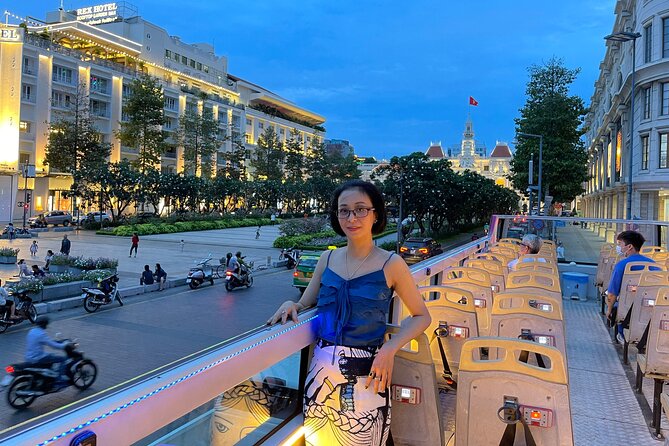
The audio guide is a core part of the experience. It is listed as available in multiple languages: English, French, German, Spanish, Chinese, Japanese, Korean, and Vietnamese. Earphones are included in the tour’s listed features too, and WiFi is available onboard.
Here’s the reality check: audio performance can vary. Some people report audio that is out of sync with what the bus is passing, or audio quality that can feel poor (like crackling or looping). That can happen when GPS timing and traffic speed don’t match the recording.
My practical advice:
- Put your earphones in right away and test them early.
- If the audio feels missing or broken, ask staff quickly before you get far into the loop.
- If audio is unreliable, use the visual cues plus the provided map to connect what you see to what it is.
Traffic and route changes: why your hour might feel longer
Even if your ticket says about one hour, evening traffic can stretch the experience. The operator notes the route can change due to traffic, holidays, weather, or other issues. That means you might see less of the planned lineup or experience slower pacing than expected.
The upside is that when the bus is moving, it delivers a satisfying snapshot of the city lights. The downside is boredom if you’re stuck. If you hate sitting in traffic, this tour may not be your favorite way to spend an evening.
Also, there is one important policy detail: if you leave the bus, you cannot get back on again. Since it’s non-stop, the “just hop off for a quick look” strategy doesn’t work.
Who this tour is best for (and who should skip it)
This is a good fit if:
- you have limited time and want a fast first look at major District 1 sights
- you like city photos at night and do not need to enter buildings
- you want a guided-feel experience without walking in heat or rain
You might skip it if:
- you need a stop-and-go itinerary where you enter sights
- you are sensitive to poor audio or out-of-sync commentary
- you’re the type who gets restless in traffic-heavy evenings
It can also be a solid family option for the lights factor, since night lighting often does the work with kids. Just remember it’s not a guided walking program at each landmark.
Should you book this night bus tour? My recommendation
Yes, book it if your priority is a low-cost overview with comfortable ride perks and you’re happy seeing landmarks from the bus window. It’s especially worth it when you want to cover big names in one evening and still keep your schedule flexible afterward.
Pause before booking if you’re expecting a true guided, stop-based tour with frequent photo breaks and building entrances. This is a moving loop, and your experience will depend on traffic and whether your audio setup works smoothly.
If you go in with the right expectations, you’ll likely enjoy the city lights and come away with a short list of places you’ll want to see properly another day.
FAQ
FAQ
What times does the night bus run in Ho Chi Minh City?
There are two schedules. The night tour runs from 16h00 to 22h30, and the midnight tour runs from 23h00 to 7h00 the next day.
How long is the tour?
The duration is listed as about 1 hour.
Is this tour hop-on hop-off?
No. It is a non-stop bus tour, and you do not have hop-on hop-off access. If you get off, you cannot get back on.
Where do I meet the bus?
The main start point is 92–96 Nguyễn Huệ, Bến Nghé, Quận 1. The end point is back in the Nguyễn Huệ area.
Are audio guides available, and in what languages?
Yes. The audio guide is available in English, French, German, Spanish, Chinese, Japanese, Korean, Vietnamese.
What is included with the ticket?
Included features list WiFi on board, an air-conditioned vehicle, earphones, a city map, insurance on the bus, a conical hat, a raincoat, and water.
Do I need to bring my own water bottle?
The operator supplies water using a large container and encourages you to bring a reusable bottle to refill, with paper cups provided for use.
What should I expect if there is traffic or bad weather?
The operator warns that the schedule and route may change due to traffic, public holidays, weather, or unforeseen issues. Traffic congestion or road closures can lead to delays, reduced frequency, or route alterations. In some cases the tour may be cancelled due to rain.